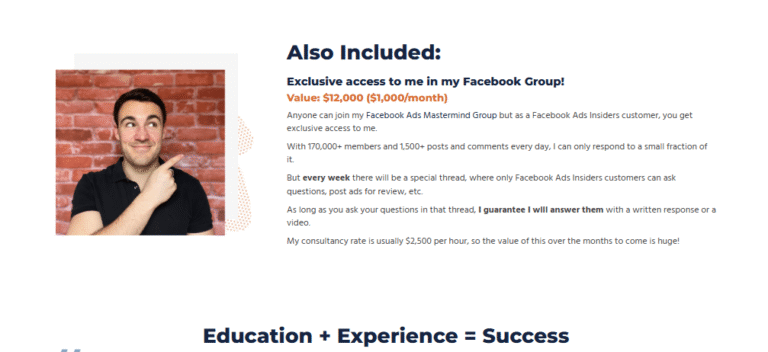
Ben Heath – Facebook Ads Mastery 2025
$99.00 Original price was: $99.00.$35.00Current price is: $35.00.

Ben Heath – Facebook Ads Mastery 2025: The Ultimate Deep-Dive Into High-Performance Meta Advertising
The digital advertising landscape continues to evolve at a pace that overwhelms even seasoned marketers, especially as privacy rules, platform algorithm updates, and consumer behavior shifts reshape how campaigns must be executed. In this environment, high-quality guidance becomes essential, and one of the most influential sources is Ben Heath. His 2025 mastery framework offers a complete system designed to help advertisers navigate Meta’s changing ecosystem with clarity, precision, and strategic depth. What makes his approach particularly valuable is how it blends data-driven techniques with simplified structures that remove unnecessary complexity, enabling consistent performance across industries and budgets.
Understanding the 2025 Meta Advertising Environment
The Meta Ads platform has introduced several updates over the past year, each influencing how campaigns should be structured. Marketers now need to understand new placements, automated campaign types, advanced optimization tools, and limitations created by privacy policies. The 2025 environment prioritizes quality content, deeper funnel understanding, and algorithm alignment more than ever before. Many beginners still try to force outdated tactics, ignoring the fact that Meta’s machine learning system rewards clean structures, patient testing, and strong feedback signals. This is one of the core themes emphasized in modern advertising: the simpler your strategy, the better your results.
A major challenge advertisers face today is the inconsistency of performance. Fluctuating CPCs, variable CPMs, and limited tracking cause confusion, making many assume the problem is their niche or product. However, most campaigns fail not because of the platform but because of misaligned expectations, weak creatives, or overly complex setups. A mastery framework allows marketers to create predictable, durable, and scalable systems that withstand platform volatility.
The Foundation: Structuring Campaigns for Algorithm Success
One of the central principles of effective Meta advertising is understanding that the algorithm performs best when given space to learn. Instead of building dozens of ad sets with different audiences, the 2025 strategy encourages fewer ad sets, broad targeting, and clean optimization goals. The algorithm can only perform well when it receives sufficient data to recognize patterns. Too many restrictions create fragmentation, budget dilution, and inefficient learning.
The recommended structure includes a simple, scalable system. A single campaign with one or two ad sets can outperform complex setups because the algorithm receives more events, faster learning cycles, and clearer optimization signals. Each ad account becomes easier to maintain and troubleshoot because you are not overwhelmed with data from too many variables. The focus is placed on testing creatives rather than testing audiences. Meta has moved toward audience automation, making interest stacking and narrow targeting less effective than before.
Creative Strategy: The Deciding Factor Behind Campaign Success
In 2025, creative performance plays the largest role in determining cost efficiency. Poor creatives cause high CPMs, low engagement, weak CTRs, and inconsistent conversion performance. Modern advertising requires careful creative planning, including multiple formats, strong hooks, emotional resonance, and clear value presentation. Video has risen to the top of preferred formats, but image and carousel formats still deliver excellent results when crafted thoughtfully.
Testing frameworks are essential for discovering winning creatives. A process that involves multiple variations of each creative type enables the advertiser to find what resonates with audiences. The algorithm must be given meaningful options to identify winners. Once a winning creative is identified, it becomes the cornerstone for scaling, and additional variations help extend its lifespan. Creative fatigue is one of the biggest causes of declining performance, so advertisers must maintain a consistent pipeline of new content.
The Full Funnel Mindset: Beyond Initial Conversions
Many marketers focus entirely on front-end conversions while ignoring the broader customer journey. The 2025 mastery framework emphasizes the value of a complete funnel approach, where each stage of the buying cycle is addressed with relevant content. Top-of-funnel ad content increases brand awareness and builds warm audiences. Middle-of-funnel ads nurture prospects with proof, demonstrations, and trust elements. Bottom-of-funnel ads drive final conversions through urgency, testimonials, or specific offers.
A well-structured funnel significantly improves ROAS because it ensures that cold audiences are not forced into buying too quickly. Instead, they flow through a system that builds familiarity and reduces resistance. This approach is particularly powerful in competitive niches where prospects need more information before making a decision.
Audience Targeting in 2025: Simplifying for Better Results
Traditional audience targeting methods have become less effective due to advances in machine learning. Meta prefers broad or Advantage+ style setups, which allow the algorithm to explore and optimize freely. While manual interests can still work for some niches, overly restrictive targeting often harms performance. The algorithm must evaluate user behavior signals across the platform to identify potential buyers.
A modern strategy includes using broad targeting for most campaigns while relying on strong creatives and optimized landing experiences to guide the right users to convert. Retargeting remains a powerful tool, but its structure has changed. Longer time windows, simplified ad sets, and blended retargeting groups are more effective than granular segmentation.
Scaling Framework: Turning Winning Ads into Long-Term Revenue
Scaling Facebook ads is typically the most challenging stage for advertisers because performance often drops when budgets increase. The 2025 mastery system emphasizes patient, data-driven scaling. Gradual budget increases and duplicating winning ad sets with adjusted budgets remain effective methods. However, horizontal scaling—expanding with new creatives—is equally important because it reduces dependence on a single angle.
Advertisers must avoid the temptation to scale too quickly. The algorithm needs time to adjust after each budget change. Rapid increases cause volatility and learning phase resets, which lead to higher costs. The best scaling strategy is consistent, incremental growth while monitoring metrics such as ROAS, CTR, cost per purchase, and frequency. Each data point reveals insights that allow the advertiser to adjust with precision.
Landing Page Optimization: Completing the Conversion Path
Once users click an ad, the landing page becomes responsible for converting interest into action. Without a high-performing landing page, even the strongest advertising strategy will fail. In 2025, landing page optimization requires fast loading times, clear value propositions, mobile-friendly layouts, and trust-building elements. The headline must match the ad to maintain message consistency, reducing bounce rates.
Heatmaps, session recordings, and A/B testing help identify friction points. Every improvement increases conversion rates, which directly improves advertising ROI. Advertisers often overlook this part of the funnel, but those who optimize continuously enjoy substantial gains in revenue.
Using Analytics and Data to Improve Long-Term Performance
Modern ad accounts generate significant data, and understanding this information is critical. Metrics such as CPM, CTR, CPC, conversion rate, and ROAS are essential, but deeper insights come from analyzing customer behavior, creative patterns, and audience interactions. Advertisers must review performance frequently, look for trends, and make adjustments based on evidence rather than assumptions.
Attribution has become more difficult due to privacy changes, so advertisers must use a combination of Facebook’s reporting tools and external analytics solutions. The goal is not to find perfect accuracy but to identify patterns that guide decision-making. The advertisers who take the time to analyze data properly can consistently outperform competitors.
Building a Sustainable Advertising Ecosystem
Short-term wins are not enough in 2025; advertisers must think long term. A sustainable ecosystem includes strong creatives, an optimized funnel, continuous testing, and processes that allow the business to adapt to changing platform conditions. Instead of relying on one winning ad or one targeting strategy, successful advertisers build systems designed to evolve.
The 2025 framework emphasizes that true mastery comes from simplicity, consistency, and strategic clarity. Many advertisers chase complex tactics, but the most effective approach is focusing on fundamentals executed at a high level.
Conclusion
The digital advertising world has changed dramatically, and success requires adapting to modern strategies, understanding algorithm behavior, and building a complete funnel that supports long-term growth. The mastery framework introduced for 2025 empowers marketers to simplify campaign structures, focus on strong creative development, and scale with confidence. As Meta continues to evolve, advertisers who apply these principles will enjoy improved performance, better conversion rates, and sustainable business growth.