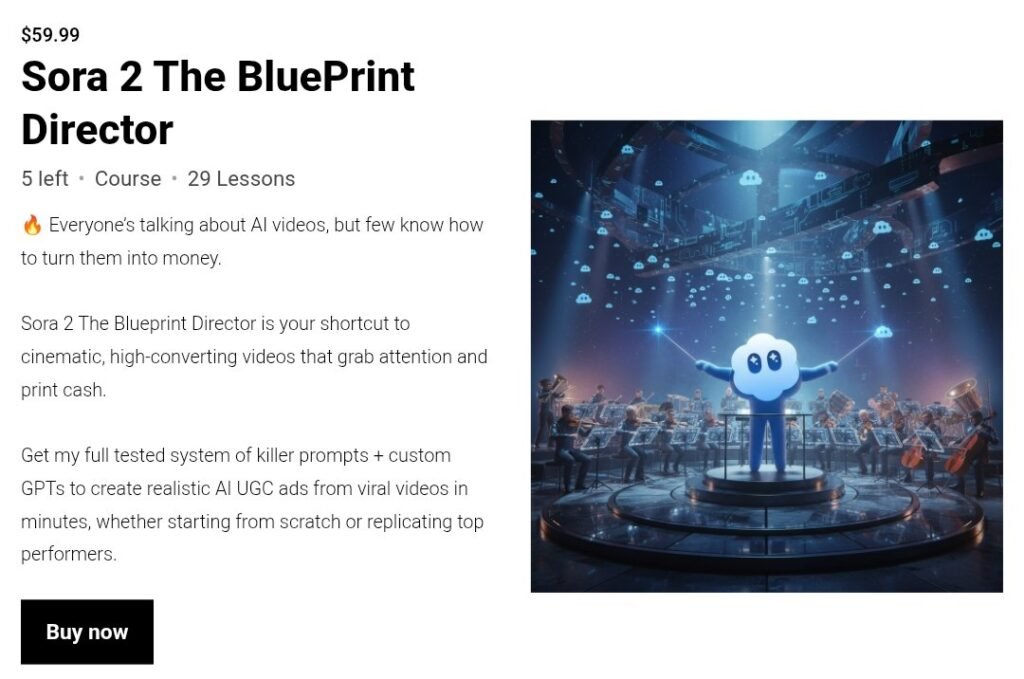
Sora 2 The BluePrint Director by GMB Crush
$59.00 Original price was: $59.00.$19.00Current price is: $19.00.

Sora 2 The BluePrint Director by GMB Crush: The Complete Deep-Dive Guide
The world of digital storytelling and visual creation has entered a new era—one where advanced AI systems empower creators to bring cinematic ideas to life with unprecedented speed, precision, and artistic depth. As video-generation technology evolves, creators are no longer limited by equipment, budget, or technical skills. Instead, they are defined by imagination.
In this rapidly shifting landscape, Sora 2 The BluePrint Director by GMB Crush emerges as a revolutionary concept that symbolizes the next stage of intelligent visual direction. This article explores the creative philosophy behind next-generation AI filmmaking, the rise of blueprint-style directing, and how future creators can adapt to an industry transformed by intelligent systems.
1. Introduction to the Blueprint Era of AI Filmmaking
1.1 What Blueprint Direction Means
Blueprint direction represents a new creative framework in which creators define the essence of a scene rather than manually controlling every technical detail. Instead of adjusting camera specs, lighting rigs, and complex timelines, creators describe:
Mood
Emotional tone
Environment
Camera behavior
Character presence
Motion flow
The AI interprets this blueprint and transforms it into cinematic visuals. This allows creators to focus on storytelling rather than technical constraints.
1.2 The Evolution of AI Video Tools
Early AI video tools were limited to short clips, simplistic animation, or rigid templates. Current-generation AI—powered by multimodal systems—has matured to the point where it understands:
Dynamic physics
Scene continuity
Cinematic language
Detailed textures
Motion patterns
Human expressions and gestures
This evolution has unlocked professional-grade video generation that rivals traditional filmmaking workflows.
2. Foundations of Intelligent Visual Creation
2.1 From Prompts to Direction
In the past, creators used simple prompts to generate visuals. Today, intelligent systems respond to complete directional frameworks, offering:
Several camera angles
Scene pacing
Lighting variations
Story-based progression
Character interaction logic
This means creators can focus on narrative flow instead of fine-grained editing.
2.2 AI as the Creative Co-Director
The partnership between human vision and machine intelligence introduces a hybrid form of creative direction:
Humans deliver expressive imagination
AI refines scenes with technical accuracy
The system learns from iterative feedback
Creativity becomes more experimental
This synergy results in video projects that are richer, faster, and more innovative.
3. Understanding the Modern AI Creator’s Mindset
3.1 Thinking in Cinematic Layers
To master AI-driven filmmaking, creators must shift to multi-layer thinking:
Narrative Layer: Story arc and emotional rhythm
Visual Layer: Aesthetic tone, style, and texture
Technical Layer: Camera movement, transitions, lighting
Symbolic Layer: Meaning behind visuals
Blueprint direction encourages deep thinking in all four layers, creating a cinematic experience with intention.
3.2 Creativity Enhanced by Intelligent Tools
AI does not replace creativity—it expands it. Creators who adopt AI tools gain:
Faster iteration
Unlimited experimentation
Scene variations in seconds
Access to styles previously impossible or costly
Ability to merge art, storytelling, and engineering effortlessly
4. Crafting Film-Ready Concepts with AI
4.1 World-Building in Seconds
Intelligent systems can construct detailed worlds:
Futuristic cities
Ancient civilizations
Mythical dimensions
Hyper-realistic environments
Minimalist or abstract visual spaces
World-building that once took weeks of rendering can now emerge in minutes.
4.2 Character Development Through AI
Characters can be crafted with:
Unique movement personalities
Distinct emotional reactions
Detailed facial expressiveness
Consistency across multiple scenes
This allows creators to produce ongoing narratives with consistent character identity.
4.3 Cinematic Motion and Camera Intelligence
Modern systems understand filmmaking mechanics:
Tracking shots
Slow pans
Aerial views
Dynamic chase sequences
Macro close-ups
Handheld realism
This gives creators a powerful toolkit for storytelling.
5. Blueprint Workflow: How Creators Build Using AI
5.1 Concept → Blueprint → Visual Output
The workflow has transformed into three core stages:
Concept Creation
Brainstorming themes, settings, emotions, and story arcs.Blueprint Development
Structuring scenes with intent, such as:“A quiet dusk scene with drifting fog and a wide-angle shot.”
“Energetic neon-lit street with rapid camera movement.”
AI Cinematic Rendering
The system generates scenes matching the expressed direction.
5.2 Iteration and Adjustment
Creators refine outputs by:
Tweaking the blueprint
Adjusting emotion levels
Introducing new props or characters
Adding motion complexity
This iterative loop mirrors the process of real directors working with cast and crew.
6. How AI Reshapes Modern Video Production
6.1 Democratizing Filmmaking
AI eliminates traditional barriers:
No need for cameras
No need for actors
No need for locations
No heavy editing
No large production budgets
Anyone can create cinematic-quality content with only imagination and direction.
6.2 Accelerating Professional Workflows
For studios and agencies, AI improves efficiency:
Rapid prototyping
Faster revisions for client approval
Cost-effective storyboard generation
Immediate visual testing of concepts
High-quality promotional content
The industry is shifting from slow production cycles to fluid, AI-enhanced workflows.
6.3 Enabling Hybrid Creative Roles
Creators can now be:
Writer
Director
Cinematographer
Visual designer
Editor
All at once, thanks to integrated AI systems.
7. Visual Style and Artistic Identity in AI Filmmaking
7.1 Defining a Unique Artistic Voice
Even with powerful AI tools, individuality matters more than ever. Creators develop their signature style by focusing on:
Color psychology
Symbolic visuals
Texture and tone
Rhythm and pacing
Consistent thematic elements
AI helps expand these elements but the artistic voice remains human-driven.
7.2 Growing a Creative Brand
By producing consistent visual themes, creators can:
Build recognition
Develop a community
Create tutorial content
Monetize their aesthetic
Collaborate with brands or studios
Blueprint-style direction enhances this consistency.
8. Ethics, Responsibility, and Creative Boundaries
8.1 Ensuring Safe and Ethical Creation
Creators must consider:
Representation accuracy
Avoiding harmful stereotypes
Knowing the limits of AI systems
Maintaining transparency with audiences
Respecting intellectual property
8.2 Building Trust in AI-Generated Content
Audiences expect authenticity. It’s essential to:
Clarify when content is AI-assisted
Avoid misleading imagery
Use AI for enhancement, not deception
8.3 The Balance of Human Intention
AI is a tool, not a replacement. Creative vision should drive every project.
9. The Future of Blueprint-Based AI Direction
9.1 Narrative AI Evolution
Soon, systems will support:
Full film-length generation
Character memory across episodes
Narrative continuity over hours
Multi-scene storyboarding in one request
9.2 Immersive and Interactive Cinema
Future content will include:
Viewer-driven narratives
Real-time branching videos
Immersive VR cinematic experiences
Responsive story universes
9.3 The Creator’s Expanding Role
Tomorrow’s creators will combine:
Storytelling
World programming
Direction
Aesthetic engineering
AI orchestration
This hybridization will redefine content creation as we know it.
10. Final Thoughts: A New Age of Creative Direction
The future of filmmaking isn’t limited by physical resources, equipment, or traditional barriers. It is defined by vision, imagination, and the ability to articulate creative intent. Blueprint-style direction, powered by advanced AI systems, represents the most significant leap in visual storytelling since the introduction of digital cameras.
Creators now have the freedom to test ideas instantly, explore limitless visual worlds, and build cinematic experiences once impossible without large production teams. As these tools evolve, they will continue to empower creators of all skill levels—helping them turn imagination into reality at unprecedented speed.
The new era of intelligent filmmaking is here, and it rewards those who dare to imagine boldl