
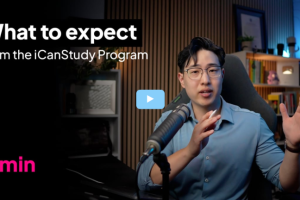
Justin Sung – iCan Study updated
$299.00 Original price was: $299.00.$29.00Current price is: $29.00.

Justin Sung – iCan Study: The Complete Guide to Smarter Learning, Deep Work, and Cognitive Mastery
Introduction: Why Modern Learning Needs a New System
In an era where information is unlimited but attention is fragile, students and professionals face a serious challenge: learning faster without sacrificing depth. Traditional study methods often focus on memorization, rigid routines, and surface-level understanding, which leads to burnout and poor long-term retention. This is exactly where Justin Sung – iCan Study has reshaped the conversation around learning.
Rather than promoting shortcuts or motivational hype, this approach emphasizes cognitive frameworks, conceptual clarity, and sustainable study systems. It treats learning as a trainable skill, not a fixed talent. The result is a method that prioritizes understanding how the brain organizes knowledge, builds expertise, and transfers skills across domains.
This guide explores the philosophy, structure, techniques, and real-world value behind the system, showing why it has become a reference point for serious learners worldwide.
Who Is Justin Sung and What Makes His Work Different?
Justin Sung is widely known for translating complex learning science into practical, trainable systems. With a background rooted in high-performance education and medical learning environments, his work bridges neuroscience, cognitive psychology, and real-world study demands.
What distinguishes his teaching style is not just what he explains, but how he explains it. Instead of isolated tips like “study longer” or “use flashcards,” he focuses on how mental models are formed, how expertise develops, and why many popular productivity methods fail over time.
The Justin Sung – iCan Study framework is built around the idea that learning is not about cramming more hours, but about upgrading how the brain processes, structures, and retrieves information.
The Core Philosophy Behind the iCan Study Method
At the heart of the system lies one central belief:
Learning effectiveness depends more on structure and cognition than on motivation or time spent.
This philosophy is supported by three foundational pillars:
1. Conceptual Learning Over Rote Memorization
Instead of storing disconnected facts, learners are trained to build conceptual maps that show how ideas relate, evolve, and apply. This dramatically improves retention, comprehension, and problem-solving.
2. Cognitive Load Management
Poor study habits often overwhelm working memory. The system teaches how to chunk information, sequence complexity, and offload mental strain so deeper thinking becomes possible.
How the Learning System Is Structured
The program architecture is designed to take learners from foundational thinking upgrades to advanced performance strategies. Rather than isolated modules, it operates as a progressive cognitive training ecosystem.
Foundational Layer: Learning How to Learn
This stage focuses on correcting broken assumptions about studying. Learners explore:
How memory actually works
Why rereading and highlighting fail
How understanding is constructed
How expertise develops over time
This resets expectations and builds the groundwork for sustainable improvement.
Cognitive Layer: Mental Models and Frameworks
Here, students learn how to:
Build knowledge structures
Identify core principles
Map relationships between ideas
Create abstraction layers
This transforms learning from linear note-taking into networked understanding.
Application Layer: Performance and Output
At this level, focus shifts to:
Exam performance
Project execution
Problem-solving speed
Real-world knowledge application
This is where the theory becomes visible in grades, confidence, and clarity.
Key Techniques Taught Inside the System
Although the philosophy is deep, the system is highly practical. Some of the most powerful techniques include:
Cognitive Mapping
Instead of writing pages of notes, learners create structured concept maps that visually represent how ideas interconnect. This strengthens comprehension and recall.
Abstraction Training
Students are trained to move between details and high-level principles. This ability is what separates surface learners from true experts.
Question-Driven Learning
Rather than passively consuming information, learners are taught to generate strategic questions that guide reading, lectures, and revision.
Knowledge Compression
Complex material is condensed into minimal frameworks, allowing faster review and stronger long-term memory traces.
Retrieval-Integrated Understanding
Recall is not used just for memorization, but for testing conceptual depth, application ability, and framework integrity.
Through these tools, Justin Sung – iCan Study evolves studying into a deliberate cognitive craft.
Why Traditional Study Methods Often Fail
Many students work extremely hard yet achieve disappointing results. This is rarely due to laziness. Instead, it comes from ineffective learning architecture.
Common problems include:
Overreliance on passive review
Excessive note rewriting
Poor differentiation between recognition and understanding
Cognitive overload without structure
Lack of feedback loops
Traditional methods often reward short-term familiarity, not durable knowledge. In contrast, this system restructures the entire learning pipeline so effort converts directly into insight.
The Role of Deep Work and Attention Control
A major theme emphasized throughout the system is attentional quality. Learning efficiency depends heavily on the state of mind in which information is processed.
Learners are guided to develop:
Distraction-resistant study environments
Structured deep work sessions
Strategic rest and recovery
Metacognitive awareness
Rather than chasing motivation, they build systems that make focus automatic. Over time, this significantly reduces burnout while improving consistency.
Applications Across Different Fields
One of the strongest advantages of this framework is adaptability. It is not confined to academic exams.
Students
Faster comprehension
Higher exam confidence
Reduced cramming
Better long-term recall
Professionals
Rapid skill acquisition
Smarter problem solving
Improved decision frameworks
Enhanced creative output
Entrepreneurs and Creators
Strategic thinking clarity
Efficient research synthesis
Stronger mental models
Better content architecture
Because the system focuses on cognitive structure, its benefits transfer naturally across domains.
Psychological Benefits Beyond Studying
While performance improvements are visible, many users report deeper psychological shifts.
These often include:
Reduced anxiety around complexity
Increased confidence in tackling new subjects
Improved intellectual independence
Greater clarity of thought
More consistent motivation
This happens because learners stop relying on willpower and start trusting structured thinking processes.
How This Approach Builds True Expertise
Expertise is not built by consuming more content. It emerges from organizing knowledge into predictive, flexible frameworks.
The system trains learners to:
Identify governing principles
Recognize patterns across topics
Generate explanations, not summaries
Test ideas through application
Continually refine internal models
Over time, this creates a compounding effect where each new subject becomes easier to learn than the last.
This is why Justin Sung – iCan Study is often described as a long-term investment rather than a quick fix.
Long-Term Learning and Career Advantage
In a world shaped by automation and rapid change, the ability to learn efficiently has become a career-level advantage.
Those who master cognitive learning systems can:
Reskill faster than peers
Adapt to industry shifts
Handle information overload
Solve complex interdisciplinary problems
This positions learning itself as a lifelong strategic asset rather than a temporary academic phase.
Common Misconceptions About Advanced Study Systems
Some people assume such systems are:
Only for top students
Too theoretical
Time-consuming
Overly complicated
In reality, most learners find that once cognitive structures are in place, studying becomes simpler, not harder. Clarity replaces confusion, and efficiency replaces brute force.
Final Thoughts: Redefining What It Means to Study
The biggest contribution of this approach is not a new technique, but a new definition of studying. Learning becomes an act of system design rather than content consumption.
By restructuring how information is processed, connected, and applied, Justin Sung – iCan Study offers a blueprint for mastering complexity in a sustainable way.
For anyone serious about long-term intellectual growth, cognitive performance, and transferable skill development, this framework represents a powerful shift from effort-based learning to architecture-based mastery.