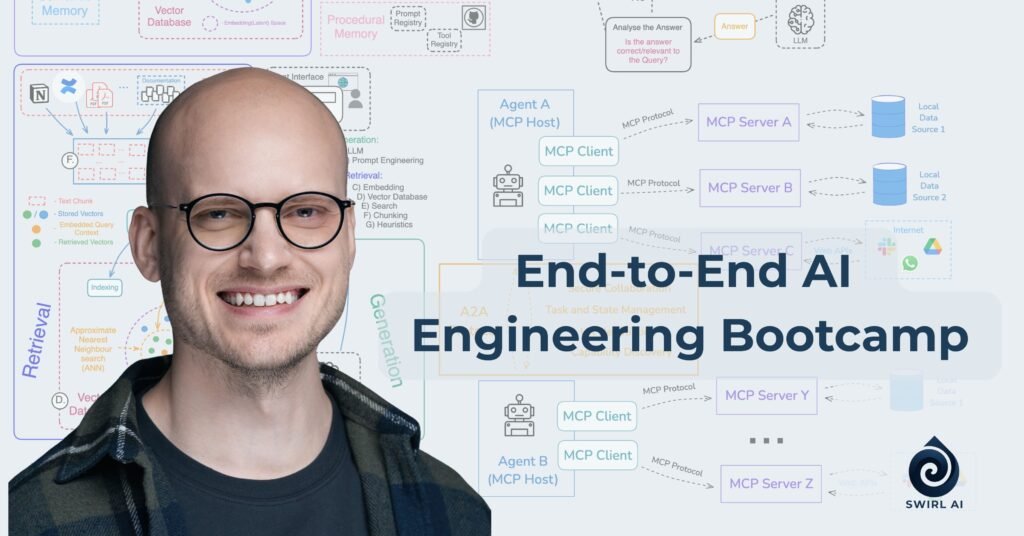
Aurimas Griciunas (Maven) – End-to-End AI Engineering Bootcamp
$1,900.00 Original price was: $1,900.00.$65.00Current price is: $65.00.

Introduction: Why End-to-End AI Engineering Matters Today
Artificial intelligence is no longer limited to research labs or experimental prototypes. It now powers recommendation engines, autonomous systems, predictive analytics, and intelligent automation across nearly every industry. As organizations race to integrate AI into their products and workflows, the demand has rapidly shifted from isolated data science roles to full-stack AI engineers who can design, build, deploy, and maintain real-world AI systems.
This shift is exactly where Aurimas Griciunas (Maven) – End-to-End AI Engineering Bootca
mp positions itself. Instead of focusing only on algorithms or only on software development, the bootcamp aims to bridge the entire AI lifecycle, from raw data to production-grade systems. The program is designed for learners who want to go beyond notebooks and experiments, and step confidently into real engineering environments.
In this detailed guide, we will explore what makes this bootcamp unique, what you can expect to learn, how it prepares you for industry, and why it stands out in a crowded field of AI courses.
Understanding the Concept of End-to-End AI Engineering
From Models to Real Products
Traditional AI education often emphasizes training models: regression, classification, deep learning, or generative architectures. While these skills are essential, they represent only a fraction of what is required in professional settings. Companies need engineers who can:
Collect and clean data at scale
Design reliable data pipelines
Build, test, and version machine learning models
Deploy systems to cloud environments
Monitor performance, bias, and drift
Continuously update and optimize AI solutions
End-to-end AI engineering brings all of these elements together. It treats AI as a living system rather than a one-time experiment.
Why Employers Prefer End-to-End Skills
Organizations today value professionals who can collaborate across data science, software engineering, and infrastructure teams. An engineer who understands the complete lifecycle reduces hand-off friction, improves reliability, and accelerates innovation. This is why structured programs that emphasize full-stack AI development have become highly attractive.
Overview of the Bootcamp’s Vision and Structure
Aurimas Griciunas (Maven) – End-to-End AI Engineering Bootcamp is designed to replicate how modern AI teams operate in real companies. Instead of fragmented lessons, it presents AI development as a coherent workflow where each stage builds on the previous one.
The bootcamp emphasizes three major pillars:
Strong theoretical foundations
Practical engineering implementation
Production-level deployment and optimization
This structure ensures that learners are not only capable of building intelligent systems, but also confident in deploying and maintaining them in professional environments.
Curriculum Breakdown: What You Learn Step by Step
1. Core Foundations of AI and Machine Learning
The journey typically begins with a solid grounding in essential concepts. This includes supervised and unsupervised learning, neural networks, and the mathematical intuition behind modern AI. Rather than overwhelming learners with abstract theory, the bootcamp connects each concept to practical use cases, showing how algorithms translate into real solutions.
Students develop a strong understanding of how data influences model behavior, why evaluation metrics matter, and how design decisions affect long-term system performance.
2. Data Engineering and Pipeline Design
Data is the backbone of any AI system. One of the defining strengths of this bootcamp is its strong emphasis on data engineering. Learners explore how to gather data from multiple sources, clean it efficiently, and structure it for scalable processing.
Topics often include:
Automated data ingestion
Feature engineering strategies
Data validation and versioning
Workflow orchestration
Building reproducible pipelines
By mastering these components, learners gain the ability to create reliable foundations upon which AI systems can evolve.
3. Model Development and Experimentation
Once data pipelines are in place, attention turns to model design and training. This stage covers both classical machine learning and modern deep learning approaches, highlighting how to choose architectures based on real-world constraints.
Learners practice:
Training and evaluating models
Hyperparameter tuning
Experiment tracking
Managing model artifacts
Ensuring reproducibility
The emphasis is not only on accuracy, but also on interpretability, efficiency, and robustness.
4. Deployment and MLOps Integration
A major differentiator of Aurimas Griciunas (Maven) – End-to-End AI Engineering Bootcamp is its strong focus on production. Learners explore how to transform trained models into services that can be used by applications, platforms, and customers.
Key skills include:
Packaging models into APIs
Cloud deployment strategies
Containerization concepts
CI/CD for machine learning
Monitoring and logging
This phase introduces the operational mindset required to run AI systems reliably over time.
5. Monitoring, Optimization, and Scaling
Real-world AI systems face challenges such as data drift, performance degradation, and changing user behavior. The bootcamp addresses these realities by teaching learners how to monitor deployed systems, detect issues, and implement updates without disrupting users.
This section often explores:
Model performance tracking
Data drift detection
Feedback loops
Continuous improvement workflows
Cost and efficiency optimization
The result is an engineer who understands that AI is not a static product, but a continuously evolving service.
Real-World Projects and Hands-On Experience
Learning by Building, Not Just Watching
One of the strongest aspects of this bootcamp is its commitment to practical application. Rather than isolated exercises, learners typically work on cohesive projects that mirror industry scenarios. These projects might include intelligent recommendation systems, predictive platforms, or automated decision tools.
Each project integrates:
Data acquisition
Pipeline construction
Model training
Deployment architecture
Performance monitoring
This holistic approach ensures that students graduate with tangible, portfolio-ready work that demonstrates real engineering competence.
Portfolio Development and Career Readiness
Completing multiple end-to-end projects gives learners concrete evidence of their abilities. Instead of merely listing tools on a resume, they can showcase full systems they have designed and deployed. This dramatically improves employability, especially for roles such as AI engineer, machine learning engineer, applied scientist, or intelligent systems developer.
Who Should Consider This Bootcamp?
Aspiring AI Engineers
Those who already understand programming fundamentals and want to transition into AI engineering will find the bootcamp particularly valuable. It provides a clear, structured pathway from core concepts to production expertise.
Data Scientists Seeking Engineering Depth
Professionals who are comfortable with modeling but lack deployment and systems experience can use this program to expand their skill set. The focus on pipelines, infrastructure, and monitoring fills a common gap in traditional data science education.
Software Engineers Moving into AI
Developers who want to integrate intelligence into applications benefit from the bootcamp’s engineering-first approach. It speaks their language, emphasizing maintainability, scalability, and system design alongside algorithms.
What Makes This Bootcamp Stand Out
End-to-End Focus
Unlike many fragmented courses, Aurimas Griciunas (Maven) – End-to-End AI Engineering Bootcamp treats AI development as a continuous lifecycle. This perspective aligns closely with real organizational needs.
Engineering-Driven Mindset
The program consistently frames AI as a production discipline rather than a research experiment. Learners adopt habits and best practices that prepare them for professional environments.
Practical Relevance
From data ingestion to monitoring deployed models, every component is presented through applied scenarios. This ensures that learners develop intuition as well as technical skill.
Long-Term Skill Value
The bootcamp does not revolve around fleeting trends. Instead, it emphasizes foundational engineering principles that remain relevant even as tools evolve.
Career Impact and Industry Opportunities
Graduates equipped with end-to-end AI skills are positioned to contribute meaningfully from their first day in a role. Organizations increasingly seek professionals who can collaborate across teams, understand system trade-offs, and take ownership of intelligent solutions.
Roles aligned with this training include:
AI Engineer
Machine Learning Engineer
Applied AI Developer
Intelligent Systems Engineer
MLOps Specialist
By mastering the full lifecycle, learners gain flexibility, making them adaptable to startups, enterprises, and research-driven companies alike.
Long-Term Value of End-to-End AI Mastery
The AI field continues to evolve rapidly, but the need for integrated, reliable systems remains constant. Engineers who understand how data flows, how models are maintained, and how infrastructure supports intelligence are positioned for sustained career growth.
Programs that emphasize complete workflows rather than isolated skills cultivate professionals who think in systems, not just scripts. This mindset is critical for leadership roles, architectural responsibilities, and innovation-driven careers.
Final Thoughts
Aurimas Griciunas (Maven) – End-to-End AI Engineering Bootcamp represents a comprehensive pathway into modern AI engineering. By uniting data engineering, machine learning, and deployment into a cohesive educational experience, it prepares learners to operate confidently in real production environments.
For anyone serious about building not just models, but living AI systems, this bootcamp offers a structured, practical, and future-oriented foundation. It transforms learners from passive consumers of AI tools into active architects of intelligent solutions.