
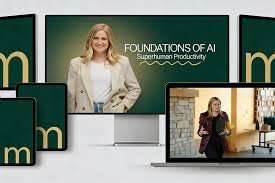
Callan Faulkner – Foundations of AI Superhuman Productivity
$997.00 Original price was: $997.00.$55.00Current price is: $55.00.

Callan Faulkner – Foundations of AI Superhuman Productivity
Introduction: A New Era of Human Performance
Artificial intelligence is no longer a distant future concept reserved for research labs and science fiction. It has quietly embedded itself into daily workflows, creative industries, business operations, and personal development systems. Professionals who understand how to collaborate with intelligent tools are not just becoming faster; they are redefining what productivity truly means. In this rapidly evolving landscape, Callan Faulkner – Foundations of AI Superhuman Productivity emerges as a structured framework that explores how humans can multiply their cognitive output, creative range, and decision-making ability by working alongside AI.
Rather than promoting shortcuts or automation for its own sake, this foundation emphasizes mastery. It shows how individuals can design intelligent systems that support deep work, strategic thinking, and meaningful creation. Productivity here is not about doing more tasks. It is about achieving higher-quality outcomes with clarity, speed, and sustained mental energy.
Understanding the Foundations of AI-Driven Productivity
Traditional productivity models focused on time management, task batching, and goal tracking. While these methods still matter, AI introduces a new dimension: adaptive intelligence. Intelligent systems can now analyze patterns, generate ideas, summarize complex material, automate repetitive work, and provide decision support.
The foundation of AI-driven productivity rests on three core principles:
Cognitive leverage – using AI to extend memory, analysis, and creative ideation.
Workflow intelligence – building systems that reduce friction and mental overhead.
Human primacy – keeping judgment, ethics, and creativity at the center.
In the Callan Faulkner – Foundations of AI Superhuman Productivity model, AI is not positioned as a replacement for human effort. Instead, it becomes a dynamic thinking partner that enhances focus, speeds learning, and amplifies strategic output.
From Automation to Augmentation
Many people associate AI with automation alone. While automation is valuable, it represents only the surface layer. The deeper transformation lies in augmentation. Augmentation means AI actively supports thinking, planning, designing, and problem solving.
This includes:
Rapid research synthesis from massive data sources
Intelligent brainstorming and creative expansion
Real-time feedback on written, visual, or strategic work
Predictive assistance for business and project decisions
When these capabilities are intentionally structured, productivity evolves from mechanical efficiency into cognitive excellence. Instead of managing endless to-do lists, professionals begin orchestrating intelligent ecosystems that adapt to goals, energy levels, and long-term vision.
The Architecture of Superhuman Productivity
True productivity does not start with tools. It starts with architecture. A superhuman productivity system is built in layers, each supporting the next.
1. The Cognitive Layer
This layer focuses on thinking quality. AI tools assist with research, outlining, summarization, and critical questioning. They reduce cognitive clutter, allowing the mind to remain focused on high-value thinking.
Examples include:
Converting raw information into structured insights
Exploring multiple perspectives instantly
Identifying gaps in logic or strategy
Supporting continuous learning loops
This layer transforms information overload into strategic clarity.
2. The Creative Layer
Creativity thrives on variation, pattern recognition, and iteration. AI excels at generating alternatives, remixing concepts, and offering novel combinations. Writers, designers, marketers, and entrepreneurs can rapidly prototype ideas before refining them with human taste and intuition.
The result is not generic output, but accelerated creative evolution.
3. The Execution Layer
Here, productivity becomes visible. Intelligent systems schedule, automate, track, and optimize workflows. Repetitive operations are delegated, while humans focus on leadership, innovation, and problem solving.
Execution becomes smoother, lighter, and significantly more scalable.
Human Skills Become More Important, Not Less
A powerful misconception is that AI reduces the value of human skill. In reality, it raises the standard. As machines handle routine processes, uniquely human abilities become central.
These include:
Strategic judgment
Emotional intelligence
Ethical reasoning
Vision building
Storytelling and persuasion
The Callan Faulkner – Foundations of AI Superhuman Productivity philosophy reinforces that superhuman productivity is not about working nonstop. It is about cultivating advanced thinking, refined creativity, and disciplined attention, all supported by intelligent tools.
Designing an AI-Integrated Daily Workflow
A practical foundation requires translation into daily habits. Superhuman productivity is built through intentional routines that align AI capabilities with personal and professional goals.
Morning: Strategic Alignment
Instead of beginning the day reacting to messages, high-performers start with clarity. AI systems can assist by summarizing priorities, reviewing long-term goals, and highlighting high-impact tasks.
This stage focuses on direction before motion.
Midday: Deep Work Amplification
During focused work blocks, AI supports research, drafting, modeling, and creative exploration. Rather than breaking concentration to search, organize, or format, individuals maintain momentum while AI handles supporting operations.
The result is deeper immersion and higher-quality output.
Evening: Reflection and Optimization
At the end of the day, AI can analyze performance patterns, capture insights, and suggest refinements. Over time, this creates a feedback loop that continuously improves decision making, energy management, and strategic planning.
Productivity becomes an evolving system, not a static routine.
Learning at Accelerated Speed
One of the most profound productivity shifts introduced by AI is learning velocity. Skills that once took years to acquire can now be scaffolded through intelligent tutoring, simulation, and personalized explanation.
AI can:
Break down complex subjects into adaptive learning paths
Test understanding through dynamic questioning
Provide instant examples across industries and contexts
Simulate scenarios for practice and decision rehearsal
This learning acceleration compounds over time, giving individuals a massive advantage in fast-changing fields.
The Role of Ethics and Responsibility
Powerful tools require responsible frameworks. Superhuman productivity must be guided by ethical awareness, transparency, and long-term thinking. Misuse of AI can create dependency, misinformation, or creative stagnation.
A strong foundation emphasizes:
Verification of outputs
Preservation of original thinking
Respect for data and privacy
Human accountability in decisions
Productivity without wisdom is unsustainable. The most effective systems align technological power with human values.
Creativity Without Burnout
Burnout often results from cognitive overload, not workload. When the mind constantly manages logistics, memory, and micro-decisions, creative energy depletes. AI-augmented productivity reduces this burden.
By externalizing organization, research, and early drafting, individuals conserve mental resources for insight, refinement, and originality. Over time, this creates a sustainable rhythm of high performance.
Instead of exhaustion, professionals experience creative continuity.
Business, Entrepreneurship, and Competitive Advantage
In business contexts, AI-driven productivity changes the economics of innovation. Small teams can now perform at levels once reserved for large organizations. Market analysis, product design, customer insight, and content creation become faster and more precise.
Entrepreneurs using structured AI systems can:
Validate ideas rapidly
Build marketing ecosystems efficiently
Optimize operations continuously
Scale intellectual output without proportional labor growth
This shifts competition away from raw manpower and toward system intelligence.
Measuring True Productivity
Traditional metrics focus on hours worked or tasks completed. Superhuman productivity measures impact, learning velocity, adaptability, and creative output.
Key indicators include:
Quality and originality of work
Speed of iteration
Strategic clarity
Emotional and cognitive sustainability
Ability to navigate complexity
The ultimate goal is not constant activity, but consistent progress toward meaningful objectives.
The Long-Term Vision
As AI systems become more integrated into daily life, productivity will no longer be a personal struggle. It will be an engineered environment. Individuals who understand how to design that environment will shape industries, culture, and innovation.
The principles behind Callan Faulkner – Foundations of AI Superhuman Productivity point toward a future where humans operate as system architects rather than task executors. In that future, thinking becomes deeper, creativity becomes broader, and progress becomes exponential.
Superhuman productivity is not about becoming machine-like. It is about becoming fully human, supported by intelligent systems that free the mind to explore, invent, and lead.
Conclusion: Building Your Own Superhuman Framework
The rise of AI marks a turning point in human performance. Those who treat it as a novelty will gain convenience. Those who treat it as a foundation will gain transformation.
By structuring workflows, learning systems, and creative processes around intelligent tools, individuals can unlock levels of output previously unimaginable. The journey requires experimentation, discipline, and ethical grounding, but the rewards extend far beyond efficiency.
The true promise of AI-driven productivity lies not in speed alone, but in expanded potential. When humans and intelligent systems evolve together, productivity becomes not just superhuman, but visionary.