
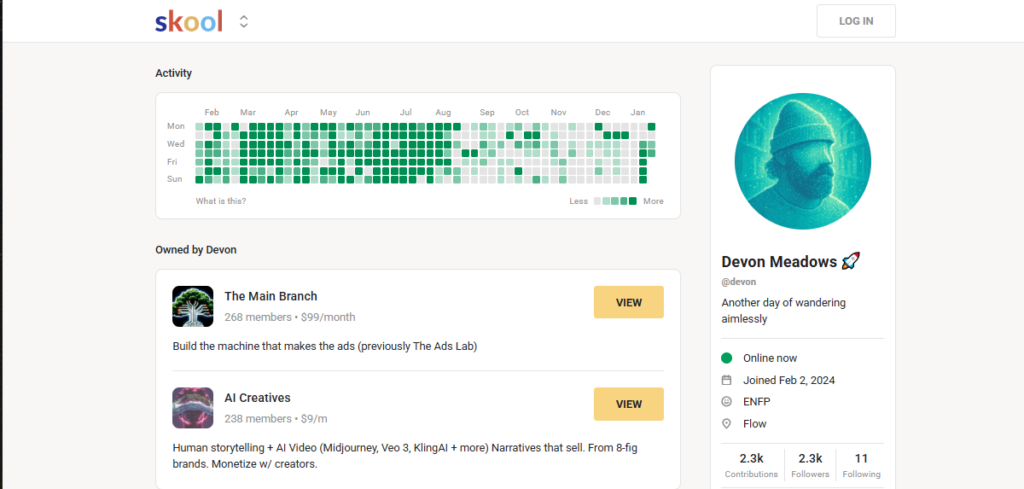
Devon Meadows – The Ads Lab
$99.00 Original price was: $99.00.$30.00Current price is: $30.00.

Introduction
In an era where digital advertising changes faster than most businesses can adapt, structured experimentation and systematic execution have become essential. Traditional “guess-and-launch” advertising models are no longer enough to compete in a marketplace dominated by automation, machine learning, and rapidly shifting consumer behavior. This is where Devon Meadows – The Ads Lab positions itself not merely as a brand, but as a philosophy of advertising built around precision, testing, and repeatable growth systems.
Rather than relying on isolated campaigns or viral luck, this approach reframes advertising as an ongoing laboratory process. Every creative, every audience, and every funnel is treated as a testable hypothesis. Success is measured, documented, optimized, and scaled. Failure is not wasted spend, but valuable data. This mindset has reshaped how modern advertisers, entrepreneurs, and digital teams think about paid traffic.
This article explores the foundations, structure, methodology, and broader impact of this lab-style advertising model, offering a deep look into why systematic ad ecosystems are redefining how growth is achieved online.
The Philosophy Behind The Ads Lab Model
At its core, the Ads Lab concept is rooted in a scientific advertising mindset. Instead of emotional decision-making or trend-chasing, it prioritizes controlled experimentation. Campaigns are not launched because they “feel right,” but because they are supported by research, data points, and test frameworks.
This philosophy draws from three central principles:
1. Advertising as a System, Not an Event
Most businesses still treat advertising as a series of disconnected launches. The Ads Lab philosophy reframes it as an evolving system composed of research, creative production, traffic management, funnel optimization, and performance analysis. Each part feeds into the other, creating a feedback loop where every campaign improves the next.
2. Data Over Opinion
Instead of debating what might work, hypotheses are validated through structured testing. Metrics such as click-through rate, cost per acquisition, retention, and lifetime value become decision engines. Creative success is not subjective; it is proven.
3. Scalability Through Documentation
One of the most overlooked aspects of performance advertising is documentation. The lab model emphasizes recording every process, result, and learning. This allows teams to scale without chaos, onboard talent faster, and build predictable revenue engines rather than fragile one-hit campaigns.
The Structure of a Modern Advertising Lab
A true advertising lab is not a single dashboard or ad account. It is a multi-layered ecosystem designed to support constant iteration.
Research and Market Intelligence Layer
Every campaign begins with deep research. This includes audience psychology, competitor analysis, offer positioning, and trend mapping. The goal is to remove assumptions and replace them with evidence-based insights. This layer determines messaging angles, creative direction, and funnel architecture.
Creative Engineering Layer
In a lab environment, creatives are engineered, not improvised. Ads are developed in variations: hooks, headlines, visual structures, emotional triggers, and calls-to-action are all modular components. This allows teams to test dozens of controlled variables without rebuilding campaigns from scratch.
Traffic and Platform Layer
This layer focuses on platform mechanics. Bidding strategies, campaign structures, audience signals, and budget pacing are carefully designed to ensure data quality. Poor structure produces misleading results, while a lab environment demands clean, interpretable data.
Conversion Architecture Layer
Ads do not exist in isolation. Funnels, landing pages, lead systems, and checkout experiences are optimized alongside traffic. This ensures that ad performance reflects true market response, not technical bottlenecks.
Analytics and Optimization Layer
The heart of any lab is measurement. Dashboards, tracking systems, and reporting frameworks transform raw numbers into actionable insight. Decisions are based on trends and cohorts, not daily emotional swings.
Why Systematic Advertising Outperforms Traditional Campaigns
The greatest weakness of traditional advertising lies in its unpredictability. One campaign may work, the next may collapse, and the reasons often remain unclear. The lab approach addresses this by replacing randomness with controlled learning.
Predictability and Risk Reduction
When campaigns are built on repeatable testing frameworks, results become more predictable. Even failed tests contribute to future success, steadily reducing the cost of customer acquisition and improving creative efficiency.
Faster Scaling Without Burnout
Chaos kills growth. Structured advertising environments allow businesses to scale spend, teams, and platforms without losing clarity. Processes replace panic. Documentation replaces tribal knowledge.
Creative Freedom Anchored by Data
Ironically, structure increases creativity. When creatives understand the testing framework, they can explore bolder ideas without risking the entire budget. Innovation becomes measurable rather than reckless.
Education, Skill Development, and The Ads Lab Mindset
One of the most important impacts of Devon Meadows – The Ads Lab concept lies in how it shapes advertisers themselves. Instead of producing button-pushers, it cultivates strategic thinkers who understand psychology, systems, and business economics.
Training Advertisers as Growth Engineers
Modern advertisers must operate at the intersection of creativity and analytics. The lab model emphasizes both. Practitioners learn not only how to launch ads, but how to design experiments, interpret behavioral data, and align campaigns with long-term business goals.
From Tactics to Thinking Frameworks
Tactics expire quickly. Platforms change, algorithms evolve, and features disappear. What remains valuable are thinking frameworks: how to test, how to evaluate, and how to systemize. This is where lab-style education provides long-term advantage.
Building Teams Around Process, Not Personalities
The lab approach reduces dependence on individual “ad geniuses.” Instead, it builds organizations around documented systems. This makes growth transferable, sustainable, and resilient to staff turnover.
Creative Testing: The Engine of Advertising Evolution
Creative performance now determines the majority of advertising outcomes. Algorithms optimize delivery, but only humans create meaning. In a lab environment, creative testing is treated with the same rigor as scientific research.
Hook-First Design Philosophy
Modern consumers scroll at extraordinary speed. The first three seconds of an ad determine everything. Lab-based advertising prioritizes hook development, testing emotional triggers such as curiosity, fear, desire, authority, and transformation.
Narrative Structures and Pattern Disruption
Beyond visuals, storytelling frameworks are tested. Problem-solution arcs, documentary styles, testimonial formats, and cinematic storytelling are all variables within controlled creative experiments.
Creative Libraries and Iteration Cycles
Winning elements are not abandoned once campaigns succeed. They are archived, dissected, and recombined into future variations. Over time, this creates a proprietary creative intelligence database unique to each brand.
Business Impact and Long-Term Value
The lab approach extends far beyond advertising performance. It reshapes business strategy itself.
Advertising as a Market Research Tool
Every campaign becomes a source of consumer insight. Language, objections, pricing sensitivity, and product perception are revealed through data rather than surveys.
Stronger Brand Positioning
When messaging is continuously tested, brands naturally refine their voice. They stop copying competitors and start reflecting what truly resonates with their audience.
Compounding Competitive Advantage
While competitors chase tactics, lab-driven organizations build knowledge assets. Over time, their understanding of their market becomes nearly impossible to replicate.
The Future of Advertising Labs
As artificial intelligence automates targeting and bidding, the human advantage will lie in experimentation, creativity, and system design. Advertising labs will increasingly resemble growth research departments rather than marketing teams.
We can expect future labs to integrate:
Predictive analytics for campaign forecasting
AI-assisted creative prototyping
Cross-platform behavioral modeling
Real-time funnel personalization
Automated experimentation pipelines
In this environment, the advertisers who thrive will not be those who know the most hacks, but those who can design the best systems.
Conclusion
Devon Meadows – The Ads Lab represents more than a name. It symbolizes a shift from chaotic advertising to structured growth engineering. By applying scientific thinking, system design, and continuous testing to paid media, this model transforms advertising from a risky expense into a predictable business asset.
In a digital economy where attention is scarce and competition is relentless, only those who treat advertising as a living laboratory will consistently evolve. The future belongs to builders of systems, not launchers of isolated campaigns.
And in that future, the concept of the advertising lab stands not as a trend, but as the foundation of sustainable digital growth.