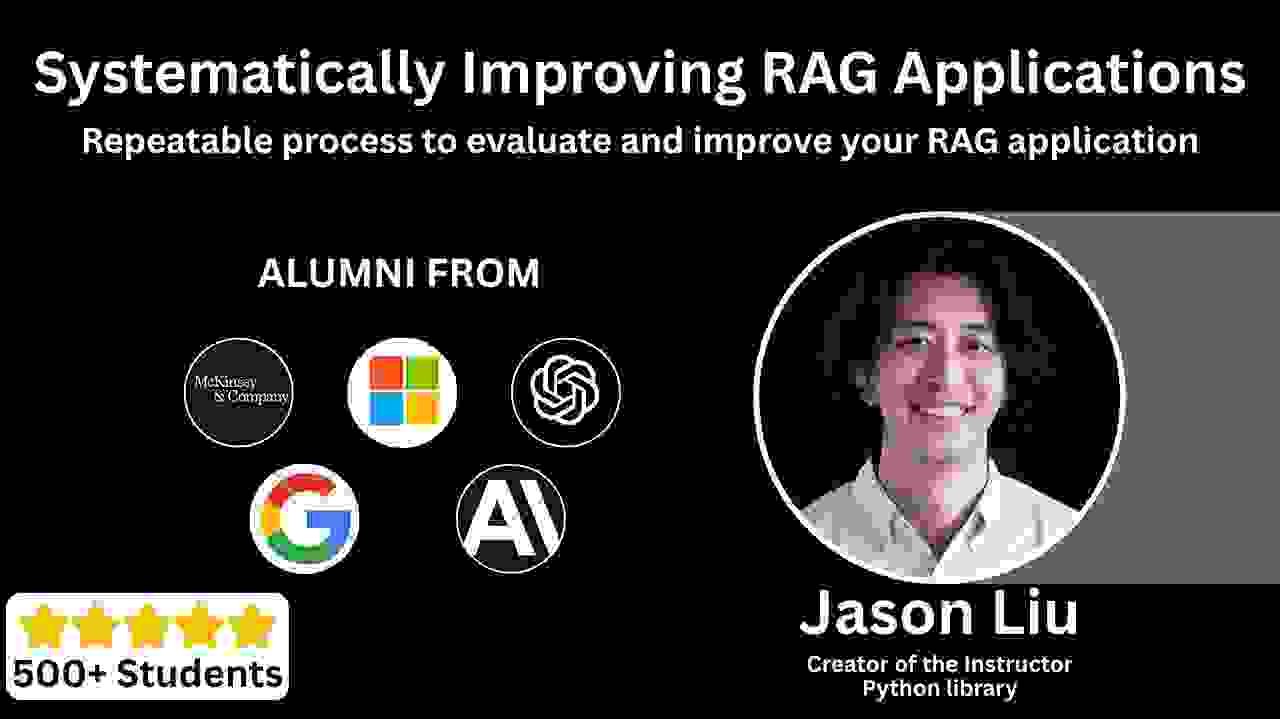
Jason Liu – Systematically Improving RAG Applications
$1,800.00 Original price was: $1,800.00.$49.00Current price is: $49.00.

Jason Liu – Systematically Improving RAG Applications
Introduction to Modern RAG Systems
Jason Liu – Systematically Improving RAG Applications represents a practical and methodical approach to advancing retrieval-augmented generation systems. Today, RAG has become a cornerstone of applied artificial intelligence. However, many implementations struggle with reliability, scalability, and evaluation. Therefore, a systematic improvement mindset is essential.
RAG systems combine information retrieval with large language models. As a result, they can answer questions using external knowledge sources. However, this promise often breaks down in real-world deployments. Consequently, Jason Liu’s framework emphasizes disciplined iteration instead of ad-hoc tuning.
Moreover, improving RAG applications requires understanding failures at every layer. This includes retrieval quality, prompt construction, model reasoning, and output evaluation. Hence, systematic thinking becomes a competitive advantage.
Understanding the Core Problems in RAG Applications
Before improving anything, problems must be clearly defined. In many RAG systems, retrieval failures go unnoticed. As a result, language models generate confident but incorrect responses.
Additionally, poor chunking strategies reduce semantic relevance. Therefore, even strong embeddings cannot compensate for structural flaws. Jason Liu highlights that most issues originate before the model generates a single token.
Furthermore, hallucinations often result from missing or ambiguous context. Because of this, blindly increasing model size rarely solves the issue. Instead, thoughtful pipeline design delivers more consistent improvements.
Jason Liu’s Philosophy of Systematic Improvement
Jason Liu – Systematically Improving RAG Applications focuses on repeatable processes rather than intuition. Instead of random experimentation, he advocates hypothesis-driven iteration. Consequently, every change has a measurable purpose.
Moreover, this philosophy treats RAG as a system, not a feature. Each component influences overall quality. Therefore, improvements must be isolated, tested, and validated independently.
Importantly, Jason Liu emphasizes documentation. By tracking changes and results, teams avoid regression. As a result, systems improve steadily over time.
Step One: Defining Clear Use Cases and Success Metrics
Every effective RAG system starts with a clear objective. Without defined use cases, optimization becomes meaningless. Therefore, Jason Liu recommends starting with specific user questions.
Next, measurable success metrics must be selected. These often include answer correctness, citation accuracy, latency, and cost. Consequently, teams can evaluate progress objectively.
Additionally, qualitative feedback remains important. However, it must complement quantitative signals. In this way, improvements remain aligned with real user needs.
Step Two: Improving Data Quality and Document Preparation
High-quality data forms the backbone of strong RAG applications. Jason Liu – Systematically Improving RAG Applications places strong emphasis on preprocessing.
First, documents must be cleaned and normalized. Inconsistent formatting confuses retrieval systems. Therefore, removing noise improves embedding consistency.
Second, chunking strategies matter deeply. Smaller chunks improve precision. However, overly small chunks lose context. As a result, chunk size must be tested systematically.
Moreover, metadata enrichment improves filtering. Consequently, retrieval becomes more targeted and reliable.
Step Three: Optimizing Retrieval Strategies
Retrieval is the most failure-prone layer of RAG systems. Therefore, Jason Liu recommends evaluating retrieval independently from generation.
Dense retrieval often outperforms keyword search. However, hybrid approaches frequently work best. By combining methods, systems capture both semantic and lexical signals.
Additionally, reranking models significantly improve relevance. Although they add latency, they often increase answer quality dramatically. Thus, trade-offs must be measured, not assumed.
Step Four: Prompt Engineering as a Controlled Variable
Prompt design should never be random. Jason Liu – Systematically Improving RAG Applications treats prompts as testable artifacts.
First, prompts should instruct models to rely only on retrieved context. This reduces hallucinations. Moreover, explicit formatting instructions improve consistency.
Second, system prompts must remain stable during experiments. Otherwise, results become unreliable. Consequently, only one variable should change at a time.
Over time, prompt libraries emerge. Therefore, teams reuse proven patterns instead of reinventing them.
Step Five: Model Selection and Configuration
Model choice influences cost, latency, and accuracy. However, larger models are not always better. Jason Liu emphasizes matching models to task complexity.
Smaller models often perform well with strong retrieval. As a result, costs decrease without sacrificing quality. Additionally, temperature and max tokens must be tuned carefully.
Furthermore, fallback models increase robustness. If one model fails, another can recover. Thus, reliability improves through redundancy.
Step Six: Evaluation and Continuous Testing
Without evaluation, improvement is impossible. Jason Liu – Systematically Improving RAG Applications strongly prioritizes automated testing.
Golden datasets serve as benchmarks. These include real questions with verified answers. Consequently, regression becomes visible immediately.
Additionally, retrieval evaluation matters as much as answer evaluation. Measuring recall and precision at retrieval time reveals upstream problems early.
Over time, evaluation pipelines become as important as the RAG system itself.
Step Seven: Error Analysis and Feedback Loops
Errors are valuable signals. Therefore, Jason Liu encourages deep error analysis instead of surface fixes.
By categorizing failures, patterns emerge. Some errors stem from retrieval. Others arise from ambiguous queries. Consequently, targeted fixes replace guesswork.
Moreover, user feedback closes the loop. When users flag incorrect answers, systems learn faster. Thus, improvement becomes continuous.
Scaling RAG Systems in Production
Production introduces new challenges. Latency, concurrency, and cost all increase in importance. Jason Liu – Systematically Improving RAG Applications accounts for these realities.
Caching frequently used queries improves speed. Additionally, asynchronous pipelines reduce perceived latency. Therefore, user experience improves significantly.
Furthermore, observability tools monitor system health. When failures occur, teams respond quickly. As a result, trust in the system grows.
Why Jason Liu’s Approach Stands Out
Many RAG guides focus on tools. Jason Liu focuses on thinking. His approach remains tool-agnostic and principle-driven.
Because of this, teams adapt easily to new frameworks. Moreover, systematic improvement scales across organizations. Therefore, long-term success becomes achievable.
Ultimately, Jason Liu – Systematically Improving RAG Applications is not about perfection. Instead, it is about consistent, measurable progress.
Conclusion
RAG systems are powerful but fragile. Without structure, they fail silently. Jason Liu’s systematic methodology provides clarity, discipline, and direction.
By improving each component deliberately, teams build reliable AI systems. Consequently, trust and performance improve together.